What do Chinese people think of the US? How has the sentiment changed over the last 10–15 years?
It has been my delight to answer Simone’s questions, which are always sharp, sensible and empathetic. So when Simone asked me for this Q&A for his upcoming book, I gladly accepted.
Simone is an Italian journalist specialising in Asia and China, where he lived for many years. Simone’s new book attempts to explain how China has viewed and continues to view the United States through a reverse timeline, starting today and tracing back to the US travels of Liang Qichao and Wu Tingfang. It seeks to understand how the official narratives mix with the perspectives of Chinese experts on China, businessmen, the first students who went to China, and the first Chinese travellers to the US. The book will be available in all Italian bookstores (publication date April 2026) and on the website of the publishing house Mondadori, Italy’s leading publisher. Simone’s previous book, “2100, How Asia Will Be, How We Will Be,” was a finalist for the Strega Prize, Italy’s most important award for non-fiction.
Q&A: A Chinese Perspective on the United States
Simone: In your view, what do Chinese people think of the United States? How has the sentiment toward the US changed over the last 10–15 years?
Robert: I’ve previously written that there are at least “two Chinas.” About 10% of the population comprises urbanites or a more liberal-leaning China, while the vast majority, around 90%, could be described as “traditionalists”. Their views of the US differ significantly and have also evolved over time.
The traditionalist China views the US quite consistently, in my observation. They see it as the world’s number one superpower but believe it consistently intends to keep China in check. A commonly cited saying encapsulates this sentiment: “帝国主义忘我之心不死The imperialist desire to exterminate us is not dead.” They are the same regular folks you may see on the streets, the cab drivers you chat with, who will always be quite friendly to individual Americans, but negative about the role of the US government.
The more liberal-leaning China, the part of China you will most likely have a deep conversation with, once held a very different view, but this has changed dramatically over the past 10 to 15 years. Around 15 years ago, this group, including myself, had an overwhelmingly positive view of the US, seeing it as a shining example of all that is good in the world, often overlooking its internal imbalances and external problems. However, in recent years, especially since Trump, many within this group have experienced a significant shift in perspective. While I’m unsure if more than half have been converted, this conversion is undoubtedly underway.
There’s also a fascinating generational divide among the liberal-leaning Chinese. Those born in the 60s and 70s tend to admire and embrace America more than younger generations do. This is understandable; during their formative years, China was in extreme poverty, while the US emerged from the Cold War as the undeniable global superpower. This generation was educated with exposure to the best aspects of America. Many of them also joined the movement in 1989 in one way or another.
In contrast, for those born after 1995 or even 2000, the picture is entirely different. They’ve grown up with a much stronger China, one that almost stands as a peer to the US, which itself has begun to show signs of imperial decline. Consequently, the fascination with the US has waned.
However, I want to stress that, whether from the traditionalist or liberal-leaning perspective, few Chinese people view the US as an “enemy” in the most visceral sense. The US is seen more as a competitor bent on weakening China. Chinese people will gladly compete, but most of them don’t frame this in terms of replacing the US as a global hegemon or in terms of destroying the US. Chinese people don’t measure success by the same metrics of the US—such as having hundreds of military bases worldwide or remaking the global order in their own image.
I anticipate people will criticise me again for “toeing the party line” or call me “CCP shill” here. But I say what I see. And if the “party line” is for peaceful co-existence, I will gladly stick my fat toes on it.
Simone: What fascinates you and what repels you about the United States?
Robert: As someone born in the year 1990, I belong to a generation that represents a watershed moment, sandwiched between cohorts with completely different worldviews. During my adolescence, the prevailing sentiment toward the US was still one of awe. American institutions, laws, economy, culture, and its sheer vitality were fascinating—and to some extent, still are. The US strikes me as the only superpower in history whose energy is largely derived from chaos: a chaos of independent minds, innovation, and a giant furnace where the best ideas are forged. Its strength feels like the energy of a young college student full of big ideas, rebelliousness, and the confidence to shape history. This youthfulness is captivating.
What repels me, however, is that same youthfulness, or more precisely, the self-righteousness born from it. When someone is young, they think they know everything, can do anything, and are always right. They tend to view those who disagree with them as inherently wrong or just plain bad people.
In comparison, China can seem like an older person who has seen it all—perhaps less inspiring, less idealistic, but also more pragmatic and more resilient, and can sometimes be surprisingly more accommodating of different opinions.
I see this paradox play out on platforms like Substack and Twitter, where I am routinely blocked by those who disagree with me (
, Michael Fritzell, Wei Ling Ling, to name but a few), while I never block them. Isn’t it ironic that the self-proclaimed champions of free speech often seem unwilling to listen to differing opinions and become the very dogmatic ideologues that they claimed to attack? This isn’t an accident but a pattern: “Agree with me, and you are my friend; disagree, and you are my enemy.”In public discourses, this self-righteousness is mildly irritating, but when it translates into real-world aggression—like the Iraq War, an action many believed was “the right thing” done with good intentions—it becomes truly dangerous, because it is extremely difficult for self-righteous people to recognise their own mistakes.
Simone: When you think of the United States, what is the first thing that comes to your mind?
Robert: Freedom. “The land of freedom” is the first association—a society paradoxically built on the participation of people who have an absolute belief in their own liberties, where many see owning a gun as a logical solution to the horrendous problem of gun violence.
Simone: Is it correct to say that, deep down, there is also a certain fascination in China with the United States?
Robert: Oh, definitely. If you know enough Chinese people, you know that we are highly competitive, both individually and collectively. We strive, consciously and unconsciously, to emulate the best. When the US represents the best, we want to emulate it. The wider the gap between the US and China, the greater the fascination. Conversely, as the gap narrows, or potentially reverses, the fascination diminishes.
I should add that this fascination has not been reciprocal—at least not until recently, the US has never been particularly fascinated by China. But things may start to change now. The outsized reaction to Dan Wang’s Breakneck is a good sign.
Simone: What do the young people you know today think of the United States?
Robert: Please refer to the answer to the first question for details on the generational perspectives.
Simone: I know this might sound like a strange question, but what do you think of phenomena like some Chinese people who appreciate Trump (such as Zhang Hongliang)? Why is that?”
Robert: I think Chinese people who like Trump are drawn to the same qualities that appeal to his American supporters: the appearance of “no bullshit.” Previous US politicians were often skilled at saying pleasant things without saying much of substance.
Chinese people are subjected to an even denser form of political bullshit in their own media. To be sure, these bullshit political messagings (some will call it “propaganda”) serve a practical purpose, which I may write about in the future. But from a human perspective, honestly, they can be quite suffocating. So, when someone like Trump appears, breaking all conventional boundaries in speech and action, it’s natural that some find him refreshing.
Simone: It seems to me that today’s Chinese Americanists mostly interpret the China-US relationship in the light of a desire for cooperation, and not confrontation, is that correct?
Robert: If by “Americanists” you mean those who study the US, then yes, there is definitely a preference for cooperation. However, people are also realistic. There’s a growing impression that cooperation is not what the majority in the US wants with China; confrontation seems inevitable. Psychologically, it’s incredibly difficult for a sitting number one power to concede that it might not remain paramount.
That said, I don’t believe China’s goal is necessarily to become number one. China wants to be the best version of itself. If others can accept that, China will be fine. But if someone stands in its way, China is unlikely to back down either.
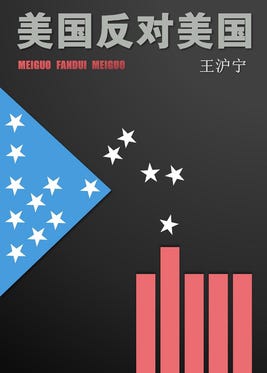
Simone: The essay America Against America by Wang Huning is widely discussed here. Is it still highly regarded in China today for understanding American affairs?
Robert: This is a strange paradox. The book is rarely mentioned publicly and is somewhat “censored”; you can’t easily find it except in obscure corners. This is likely because Wang is now one of the most powerful leaders in China, and matters concerning the top leadership are highly sensitive. However, among intellectuals with access to information, the book is highly regarded. Many marvel at how he could write such an incisive analysis of America based on just a six-month stay, over 30 years ago, at a time when most of his peers viewed the US with nothing but admiration.
Do you agree with the statement that the Chinese know the West better than the West knows China?”
Robert: Absolutely. I believe this is the ultimate strategic asymmetry and a key leverage point for China. If we calculate the ratio of people who understand the other side to the total population, China’s ratio is likely orders of magnitude higher than that of the US.
Consider language skills: How many Americans can speak Mandarin and read Chinese fluently? The top, top end of my estimate for this will stand at 10,000 people, or about 0.003% of the population. By contrast, the number of Chinese who can speak, read, and write English fluently is safely in the millions, perhaps 1% of the population when considering functional English speakers due to high school curricula. That’s a whopping 100 - 1000 times more people in absolute terms, and 30 times more in relative terms.
With such a big gap in terms of understanding basic language, it’s no accident that the gap goes much deeper into other areas.
I can safely bet that 1000 times more Chinese people know what the three branches of the US government are than Americans who know what a “Politburo” is actually made of, and perhaps 10000 more Chinese know the US capital is Washington, DC, than Americans know that the capital city of China is Beijing.
Here in China, many of the commentators have a massive body of knowledge on the other side, having been educated at places like Harvard and Yale. In the US, however, you have people like Noah Smith who writes profusely about China without ever even visiting China or speaking Chinese, and his hundreds of thousands of subscribers don’t seem to find that problematic.
People like Wang Huning, nominally the 4th-most-powerful person in China right now, could have written a masterpiece about the US more than 30 years ago. Can Marco Rubio write a book about China with the same pedigree?
This is a significant, though often overlooked, advantage for China. In a situation where one side’s likelihood of misfiring is way higher than the other side's, the other side holds a huge advantage. Just why do you think Donald Trump botched his trade war with China?
*This Q&A is part of the “Mirror in the mirror” series of China Translated, where I explore the Chinese and American perceptions of the other side.